What follows is some information on what the sideshow was all about. This is being written as a resource for people who want to know a bit about where the sideshow came from and where it has ended up. If what is written here intrigues you then I recommend you search out copies of the various volumes of James Taylor's Shocked and Amazed.
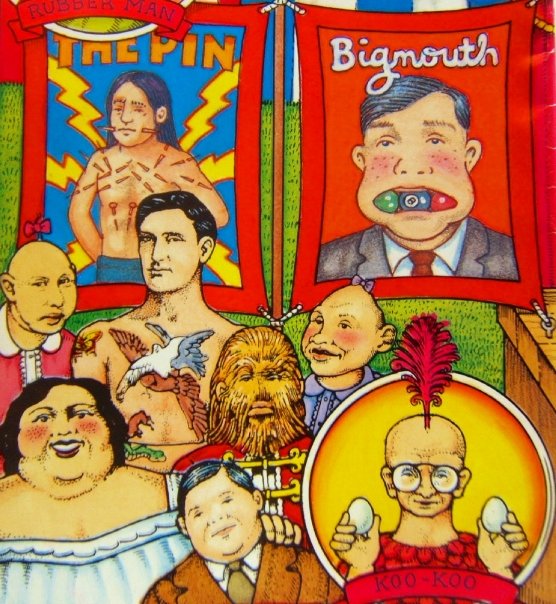
First off, let's define some terms. When the term sideshow is used, it refers to a display of people with physical abnormalities (often referred to as freaks), performers with exotic abilities (such as fire eating or sword swallowing and known as working acts), unusual objects (mummies and the preserved remains of a two headed baby are good examples) or combinations of any or all three.
The people who ran the shows are called showmen or showwomen. At carnivals and circuses these displays were housed in tents that were on the side of the midway.
On the carnival, these shows were also called backend shows because they were found at the back of the midway beyond the rides, games and food stands. Sideshows were also found at amusement parks and areas, like New York's Coney Island and Chicago's Riverview Park. At amusement parks, sideshows were often housed in buildings. Sometimes during the winter months, when the carnivals and circuses were not touring, showmen would put their sideshows into storefronts in the downtown sections of large cities. These were known as store shows.
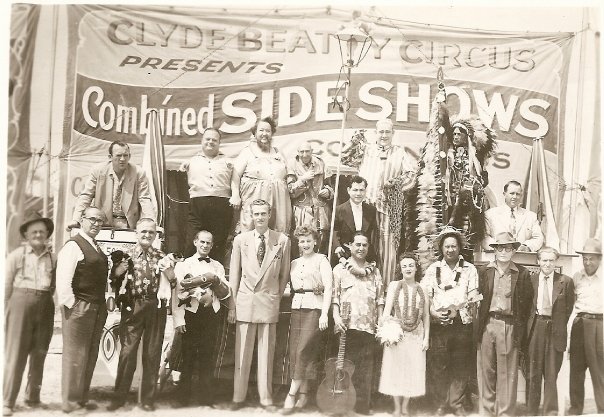
There are two kinds of sideshows. When a single person or object is featured, it is known as a single-o. When there are ten acts in the show, it's called a ten-in-one. Another name for the ten-in-one is a string show, because the various acts are strung together to make a show. Throughout the years there have been a number of shows were smaller than a ten-in-one, such as Ward Hall's Pygmy Village six-in-one that he presented in the early 1960s, and there a have been shows with more than ten acts, such as the Ringling Bros. Barnum & Bailey Circus sideshow of the 1950s which had 16 acts and a cast of 33 performers.
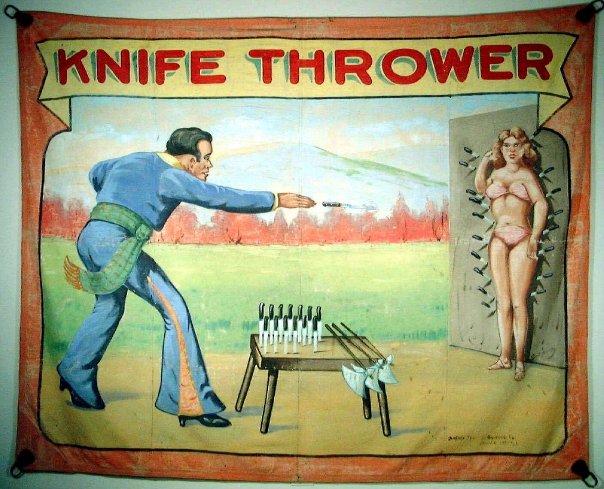
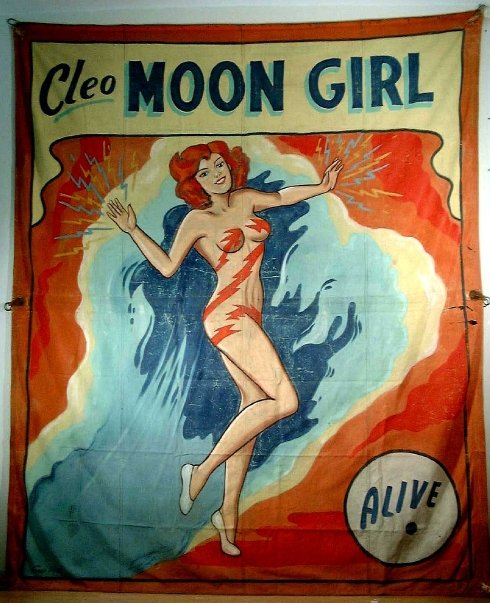
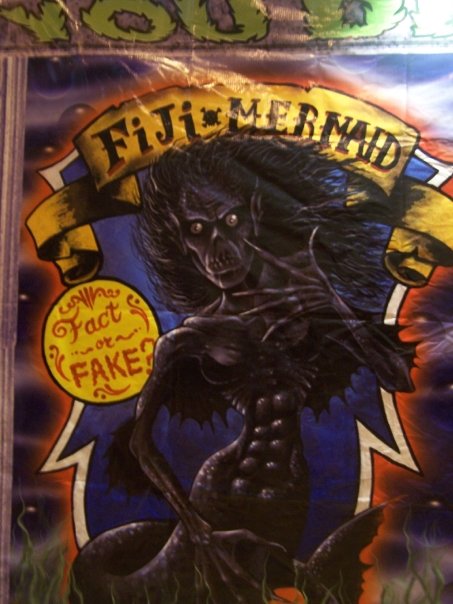
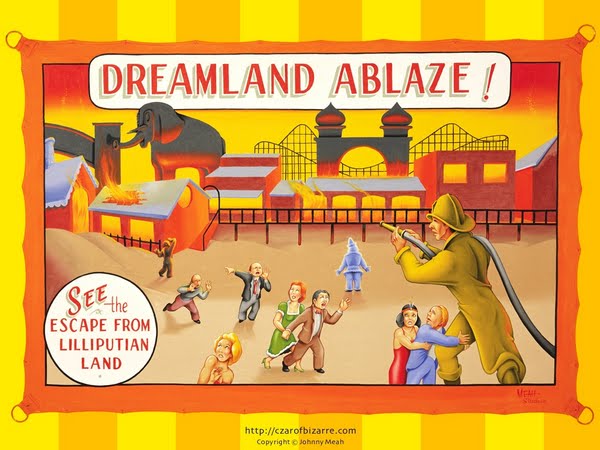
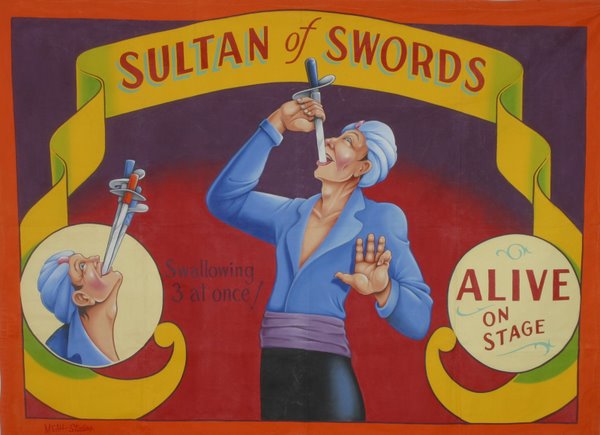
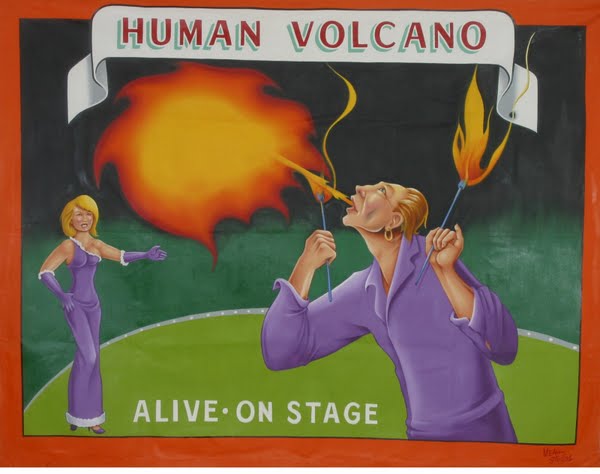
The shows used many traditional elements. To entice people to buy a ticket, large colorful canvas banners were hung on the front of the tent or building. Exaggerated depictions of the acts featured in the show were painted on these banners. Also, many shows featured an outside talker doing ballys. The outside talker was the person who stood on a small stage in front of the show and did a sales pitch for the show. This person is often erroneously called a barker. That sales pitch, which also often included a short performance by some of the show's performers, is known as a Bally. Inside the show, the crowd would stand and watch the performance. The acts would be presented on a long, high catwalk stage; multiple stages, in a roped off area on the ground (known as a pit) or some combination of these performance spots. The shows were often done continuously, with no beginning or end, just one act after another. This is known as a grind show. When people would see an act come to the stage a second time, they would know they had seen a complete show and would exit.
The preceding description was written in the past tense, because the American ten-in-one sideshow has all but vanished. There are, however, a few traditional shows left. One is Sideshow by the Seashore in Coney Island. Legendary carnival showman Ward Hall and his partner Chris Christ still takes out their World of Wonders show.
If you run into a show on a midway, chances are it will be a single-o. As for the origins of the sideshow, they go back to before recorded history. It seems that people have always been interested in the unusual. England's St. Bartholomew Fair started in 1102, and from the beginning showmen presented there oddities that were beyond what people saw in their everyday lives. Proof of how far back the public's fascination with the strange goes can be found in the plays of William Shakespeare. In the Tempest, Trinculo meets the mutant man/lizard Caliban and schemes to take him back to civilization. Commenting on the public's desires, he says, "When they will not give a doit (a cheap coin) to relieve a lame beggar, they will lay out ten to see a dead Indian."
Through the years leading up to the 19th century, showmen would rent out back rooms of taverns, meeting halls or theaters to present their exhibits. For the most part this was happening all over Europe, and to a limited degree, in colonial America. All sorts of strangeness was being presented, from people with too few or too many limbs to people with unusual abilities such as sword swallowing and fire eating. Read Ricky Jay's Learned Pigs and Fire Proof Women to get an idea of the wonders people have paid to see throughout history.
When dime museums came into being towards the end of the 18th century, and began to flourish in American, they provided the perfect venue for oddities. The dime museum got its name from its admission price and they were not unlike the Ripley's and Guinness museums of today. They also featured the display of human oddities, live performance of variety acts and plays such as Uncle Tom's Cabin.
The most famous dime museum was P.T.Barnum's American Museum, located at Ann St. and Broadway in lower Manhattan. Between the early 1840s to the late 1860s, it was THE New York tourist attraction. In addition to Barnum's museum, there were many smaller ones in NY. Many of these were found on the Bowery. Most cities of decent size had at least one dime museum. The last of the dime museums was Hubert's Museum on 42nd St. in New York. It closed down in the early 1970s.
During this same period when dime museums were getting their start, agricultural fairs were springing up around the United States. Showmen made the most of this development by taking their shows and putting them on display in tents at these fairs.
Circuses were also getting into the act. The earliest account of a sideshow with a circus goes back to the 1850s and tells of a wax museum show trouping with a circus.Though these were sideshows, they were not the ten-in-ones. For the most part during it this time, the shows you would find at fairs and circuses were single-os. The irony is that this is how the traveling sideshow got it's start and this is how it has ended up today. For a good overview of this kind of show, read A.W. Stencell's great new book, Seeing Is Believing.
The circus sideshow really hit its stride when P.T. Barnum devoted his attention to creating a touring show. When his American Museum was destroyed by fire for a second time in the late 1860s, Barnum decided to take his show on the road. He went on tour with his circus. The problem was that the circus at this time was considered a low form of entertainment. They were often filled with ticket sellers that short changed the customers, Three Card Monte and Three Shell Game mobs and showmen that would slip out of town without paying their bills.
In order to distance himself from being associated with all this, Barnum featured not only a circus, but also large tents that housed many other kinds of "enlightening" entertainment. These included a menagerie, a hall of freaks and even a collection of ancient statues! As time went on, the concept was streamlined down to just the freak show and menagerie touring with the circus. Barnum's show set a high water mark that other showmen worked to emulate.
Another important turning point was the 1893 Columbian Exposition in Chicago. At this world's fair, America was introduced to the Ferris Wheel, what we now refer to as belly dancing was brought into the mainstream and the term ballyhoo was coined. W. O. Taylor was the manager of the Streets of Cairo pavilion at the fair. In order to drum up business, he would have some of the Middle Eastern performers come out onto the midway and give a small show. This gave the fair patrons a taste of the sights and sounds to be found inside the pavilion. When the performers came out they would shout, "D'Allah hoon!" with loosely translated means, "For the love of Allah." Taylor did not speak their language, so when he wanted one of these traffic generating performances done he would call out, "Come out and do one of those ballyhoos." The word was picked up by the other showmen at the fair and has come to mean an attention-getting spectacle.The greatest significance of the Chicago fair was that it proved that when rides, shows and attractions were brought together, it was a profitable combination.
Some of the showmen banned together after the fair closed and formed the first carnival companies. Walter Sibley is credited with creating the first carnival ten-in-one in 1904, though it is not clear how this show's form differed from the sideshows that had been playing with circuses for several decades.
The creation of the carnival at the turn of the twentieth century coincided with social changes in America. The workweek was shortened and the labor movement pushed for a rise in wages. This meant that people had not only some leisure time, but also extra money to spend. And the sideshow showmen were there to give them something to spend it on.In the 1890s, the area of the South end of Brooklyn, NY, known as Coney Island, began to blossom. First, there was Capt.Boyton's Sea Lion Park. This was soon followed by George Tilyou's Steeplechase Park. Not long after the dawn of the twentieth century, Sea Lion Park was rebuilt as Luna Park and then Dreamland was the last to complete the picture. In addition to these amusement parks, there were dozens and dozens of independent rides, shows and attractions. If there was not a sideshow within the confines of a park, there was one to be found nearby.
The grandest sideshow in Coney Island was built on the site of Dreamland when that glorious park burned down in 1911. While the ground was still smoldering, showman Samuel Gumpertz set up the Dreamland Sideshow. For more than twenty years it featured the finest in sideshow performance including being the home of Barnum's Zip-The What Is It? Many of the freaks that were featured in the Tod Browning horror classic "Freaks" worked at the Dreamland Sideshow.
In addition to this show, there were many others including those run by Dave Rosen, Fred Sindell and Sam Wagner. Photographer Edward Kelty took cast photos of many of these shows in the 1920s. A number of these wonderful pictures can be found in the recently publish book by Miles Barth, Step Right This Way.From the beginning of the century up through the 1920s, the sideshow sailed along with the times. As the country dealt with the Great Depression of the 1930s, there were a number of changes that affected the sideshow. First off, there were a number of improvements in pre-natal care that decreased the number of babies born with physical abnormalities. Second, there was a change in public attitude. Many people started to look upon sideshow freaks as objects of pity. Instead of a sideshow stage, many felt that institutions were the best place for these "poor people" and putting them there was "for their own good". Fortunately, this movement fell short of legislation.
Another factor, and the one that had an impact on the sideshow was the advancements in the sophistication of the media. Sideshow claimed to bring to the stage wonders from the four corners of the earth. Starting in the late 1920s, people could see the actual people and places featured in newsreels at the local movie house. Radio also brought the world into their living rooms. It was getting harder for showmen to successfully pull of some of the hoaxes and humbugs they had been doing for decades, such as presenting people as the Wild Man of Borneo or the last of the Aztecs.
However, all was not doom and gloom in the 1930's. Robert Ripley was riding high with his Ripley's Believe It or Not cartoons in hundreds of papers. There were also Ripley's Odditoriums featuring live performers at all the of the World's Fair and other major exhibitions, and in many large cities such as New York. Robert Ripley proved once again that people were fascinated by the unusual.
On the midway and at circuses, sideshows were still very popular. Clyde Ingalls made sure that Ringling Brothers, Barnum & Bailey Circus Sideshow was an unforgettable presentation. Harry Lewiston, Ray Marsh Brydon, Dick Best and Slim Kelley were just three among many that took out shows and did well playing fairs.
After World War II, there were more changes that started the decline of the American Sideshow. There were a number of advancements in ride design and construction that came out of Europe. Rides became larger and more elaborate. Carnival owners got into a race to see who would have the latest and greatest of rides. This meant that something on the midway had to go to make room for the new rides. What went were the shows.
This did not happen over night. It took thirty years for the sideshow to vanish from the midway.During this time there were two people that were (and I am glad to report, still are) active in the sideshow business. One is Ward Hall and the other is Bobby Reynolds. Both got their starts working as magicians in the sideshow. Ward got is start in the mid 1940s in the Dailey Bros. Circus Sideshow and Bobby broke into the business a few years later out in Coney Island, NY.
Soon they both became owners of their own traveling sideshows. Both Ward and Bobby bought out the shows of the older generation of sideshow showman as these old timers began to retire or die off. These actions came from a desire to eliminate the competition. The problem was that when they bought these shows, they took them off the road. The shows were replaced with a ride. Once that space was used up by rides, there would no going back to a midway filled with shows. One carnival owner boasted that he was happy with a midway that didn't eat (that is, one without live performers). His operating costs less and because he had the grandest and most glorious rides (known in the trade a pig iron) he got many of the most lucrative contracts to play the big state fairs.
By the 1980s, a full ten-in-one carnival sideshow was hard to find. The economics of the carnival had become all must hostile to sideshows. If a showman could find a carnival willing to make room for his show on a midway, he had to pay as much as 60% of its gross to the carnival owner. From what was left, the show owner also had to pay for the electricity his show used and other operating expenses. Add to this that he was responsible for the payroll for his show and you see why it was next to impossible to make a sideshow profitable. And let's not forget that this is outdoor show business. Bad weather could bankrupt a show in no time at all.
The last circus to carry a sideshow was the Kelly-Miller Circus, and it stopped that tradition back in 1995. The L.E. Barnes Circus took out a sideshow in the summer of 2001, but that circus only lasted a single season. Just about all that's left on the carnival midway are a few single-os owned by people like Jack Constantine, Jeff Murray and Pete Kolozsky, the traveling oddities museums (often with live acts) of Lee Kolozsky and Jim Zajicek; and the freak animal show of John Strong.
In the mid 1980s, a graduate from the Yale School of Drama named Dick Zigun came to Coney Island. He hooked up with showman John Bradshaw, who was running what was left of the old Slim Kelley/Whitey Sutton Sideshow, and they opened Sideshows by the Seashore. Bradshaw left after several seasons and Zigun has carried on. This permanent sideshow company is still going strong today and is last of its kind anywhere.
Towards the end of the 1980s, a street performer named Jim Rose, known as Jimmy the Geek, got together a number of other performers up in the Seattle, WA area. They formed a troupe called Jim Rose Circus Sideshow and played rock and roll clubs in the area. They took traditional sideshow acts and retooled them for a rock sensibility. This hard core show received national publicity, including a full hour on the Sally Jesse Raphael show. They got an offer to play the Lollapalooza Tour and this led to several national and international tours. Though several of the original troupe, like Tim "the Torture King" Cridland, have left to form their own touring companies, Rose still tours today and was the subject of a short lived Travel Channel reality series.
Inspired by the success of Jim Rose, a number of other troupes have sprung up in recent years, including the Blue Monkey Sideshow (Indianapolis, IN) and the Bindlestiff Family Cirkus (New York, NY). Many performers, like myself, have found work performing a one-man sideshow. We do all the acts and perform in a wide variety of venues, such as colleges, Renaissance Faires, comedy clubs, corporate events, tradeshows, theaters and tattoo shows (like the European Wildstyle Show). A few of the notable performers working today are Harley Newman, Johnny Meah (the last of the sideshow banner painters and fine sword swallower), Sideshow Bennie, Johnny Fox,Ses Carny, Erik "The Lizardman" Sprague and Doc Swan.
It is doubtful that the sideshow will ever return to the carnival, circus or amusement park. Instead, a number of performers, such as myself, are taking the ancient traditions of the sideshow, making them their own, playing new venues and introducing a whole new audience to the world of the sideshow.
First off, let's define some terms. When the term sideshow is used, it refers to a display of people with physical abnormalities (often referred to as freaks), performers with exotic abilities (such as fire eating or sword swallowing and known as working acts), unusual objects (mummies and the preserved remains of a two headed baby are good examples) or combinations of any or all three.
The people who ran the shows are called showmen or showwomen. At carnivals and circuses these displays were housed in tents that were on the side of the midway.
On the carnival, these shows were also called backend shows because they were found at the back of the midway beyond the rides, games and food stands. Sideshows were also found at amusement parks and areas, like New York's Coney Island and Chicago's Riverview Park. At amusement parks, sideshows were often housed in buildings. Sometimes during the winter months, when the carnivals and circuses were not touring, showmen would put their sideshows into storefronts in the downtown sections of large cities. These were known as store shows.
There are two kinds of sideshows. When a single person or object is featured, it is known as a single-o. When there are ten acts in the show, it's called a ten-in-one. Another name for the ten-in-one is a string show, because the various acts are strung together to make a show. Throughout the years there have been a number of shows were smaller than a ten-in-one, such as Ward Hall's Pygmy Village six-in-one that he presented in the early 1960s, and there a have been shows with more than ten acts, such as the Ringling Bros. Barnum & Bailey Circus sideshow of the 1950s which had 16 acts and a cast of 33 performers.
The shows used many traditional elements. To entice people to buy a ticket, large colorful canvas banners were hung on the front of the tent or building. Exaggerated depictions of the acts featured in the show were painted on these banners. Also, many shows featured an outside talker doing ballys. The outside talker was the person who stood on a small stage in front of the show and did a sales pitch for the show. This person is often erroneously called a barker. That sales pitch, which also often included a short performance by some of the show's performers, is known as a Bally. Inside the show, the crowd would stand and watch the performance. The acts would be presented on a long, high catwalk stage; multiple stages, in a roped off area on the ground (known as a pit) or some combination of these performance spots. The shows were often done continuously, with no beginning or end, just one act after another. This is known as a grind show. When people would see an act come to the stage a second time, they would know they had seen a complete show and would exit.
The preceding description was written in the past tense, because the American ten-in-one sideshow has all but vanished. There are, however, a few traditional shows left. One is Sideshow by the Seashore in Coney Island. Legendary carnival showman Ward Hall and his partner Chris Christ still takes out their World of Wonders show.
If you run into a show on a midway, chances are it will be a single-o. As for the origins of the sideshow, they go back to before recorded history. It seems that people have always been interested in the unusual. England's St. Bartholomew Fair started in 1102, and from the beginning showmen presented there oddities that were beyond what people saw in their everyday lives. Proof of how far back the public's fascination with the strange goes can be found in the plays of William Shakespeare. In the Tempest, Trinculo meets the mutant man/lizard Caliban and schemes to take him back to civilization. Commenting on the public's desires, he says, "When they will not give a doit (a cheap coin) to relieve a lame beggar, they will lay out ten to see a dead Indian."
Through the years leading up to the 19th century, showmen would rent out back rooms of taverns, meeting halls or theaters to present their exhibits. For the most part this was happening all over Europe, and to a limited degree, in colonial America. All sorts of strangeness was being presented, from people with too few or too many limbs to people with unusual abilities such as sword swallowing and fire eating. Read Ricky Jay's Learned Pigs and Fire Proof Women to get an idea of the wonders people have paid to see throughout history.
When dime museums came into being towards the end of the 18th century, and began to flourish in American, they provided the perfect venue for oddities. The dime museum got its name from its admission price and they were not unlike the Ripley's and Guinness museums of today. They also featured the display of human oddities, live performance of variety acts and plays such as Uncle Tom's Cabin.
The most famous dime museum was P.T.Barnum's American Museum, located at Ann St. and Broadway in lower Manhattan. Between the early 1840s to the late 1860s, it was THE New York tourist attraction. In addition to Barnum's museum, there were many smaller ones in NY. Many of these were found on the Bowery. Most cities of decent size had at least one dime museum. The last of the dime museums was Hubert's Museum on 42nd St. in New York. It closed down in the early 1970s.
During this same period when dime museums were getting their start, agricultural fairs were springing up around the United States. Showmen made the most of this development by taking their shows and putting them on display in tents at these fairs.
Circuses were also getting into the act. The earliest account of a sideshow with a circus goes back to the 1850s and tells of a wax museum show trouping with a circus.Though these were sideshows, they were not the ten-in-ones. For the most part during it this time, the shows you would find at fairs and circuses were single-os. The irony is that this is how the traveling sideshow got it's start and this is how it has ended up today. For a good overview of this kind of show, read A.W. Stencell's great new book, Seeing Is Believing.
The circus sideshow really hit its stride when P.T. Barnum devoted his attention to creating a touring show. When his American Museum was destroyed by fire for a second time in the late 1860s, Barnum decided to take his show on the road. He went on tour with his circus. The problem was that the circus at this time was considered a low form of entertainment. They were often filled with ticket sellers that short changed the customers, Three Card Monte and Three Shell Game mobs and showmen that would slip out of town without paying their bills.
In order to distance himself from being associated with all this, Barnum featured not only a circus, but also large tents that housed many other kinds of "enlightening" entertainment. These included a menagerie, a hall of freaks and even a collection of ancient statues! As time went on, the concept was streamlined down to just the freak show and menagerie touring with the circus. Barnum's show set a high water mark that other showmen worked to emulate.
Another important turning point was the 1893 Columbian Exposition in Chicago. At this world's fair, America was introduced to the Ferris Wheel, what we now refer to as belly dancing was brought into the mainstream and the term ballyhoo was coined. W. O. Taylor was the manager of the Streets of Cairo pavilion at the fair. In order to drum up business, he would have some of the Middle Eastern performers come out onto the midway and give a small show. This gave the fair patrons a taste of the sights and sounds to be found inside the pavilion. When the performers came out they would shout, "D'Allah hoon!" with loosely translated means, "For the love of Allah." Taylor did not speak their language, so when he wanted one of these traffic generating performances done he would call out, "Come out and do one of those ballyhoos." The word was picked up by the other showmen at the fair and has come to mean an attention-getting spectacle.The greatest significance of the Chicago fair was that it proved that when rides, shows and attractions were brought together, it was a profitable combination.
Some of the showmen banned together after the fair closed and formed the first carnival companies. Walter Sibley is credited with creating the first carnival ten-in-one in 1904, though it is not clear how this show's form differed from the sideshows that had been playing with circuses for several decades.
The creation of the carnival at the turn of the twentieth century coincided with social changes in America. The workweek was shortened and the labor movement pushed for a rise in wages. This meant that people had not only some leisure time, but also extra money to spend. And the sideshow showmen were there to give them something to spend it on.In the 1890s, the area of the South end of Brooklyn, NY, known as Coney Island, began to blossom. First, there was Capt.Boyton's Sea Lion Park. This was soon followed by George Tilyou's Steeplechase Park. Not long after the dawn of the twentieth century, Sea Lion Park was rebuilt as Luna Park and then Dreamland was the last to complete the picture. In addition to these amusement parks, there were dozens and dozens of independent rides, shows and attractions. If there was not a sideshow within the confines of a park, there was one to be found nearby.
The grandest sideshow in Coney Island was built on the site of Dreamland when that glorious park burned down in 1911. While the ground was still smoldering, showman Samuel Gumpertz set up the Dreamland Sideshow. For more than twenty years it featured the finest in sideshow performance including being the home of Barnum's Zip-The What Is It? Many of the freaks that were featured in the Tod Browning horror classic "Freaks" worked at the Dreamland Sideshow.
In addition to this show, there were many others including those run by Dave Rosen, Fred Sindell and Sam Wagner. Photographer Edward Kelty took cast photos of many of these shows in the 1920s. A number of these wonderful pictures can be found in the recently publish book by Miles Barth, Step Right This Way.From the beginning of the century up through the 1920s, the sideshow sailed along with the times. As the country dealt with the Great Depression of the 1930s, there were a number of changes that affected the sideshow. First off, there were a number of improvements in pre-natal care that decreased the number of babies born with physical abnormalities. Second, there was a change in public attitude. Many people started to look upon sideshow freaks as objects of pity. Instead of a sideshow stage, many felt that institutions were the best place for these "poor people" and putting them there was "for their own good". Fortunately, this movement fell short of legislation.
Another factor, and the one that had an impact on the sideshow was the advancements in the sophistication of the media. Sideshow claimed to bring to the stage wonders from the four corners of the earth. Starting in the late 1920s, people could see the actual people and places featured in newsreels at the local movie house. Radio also brought the world into their living rooms. It was getting harder for showmen to successfully pull of some of the hoaxes and humbugs they had been doing for decades, such as presenting people as the Wild Man of Borneo or the last of the Aztecs.
However, all was not doom and gloom in the 1930's. Robert Ripley was riding high with his Ripley's Believe It or Not cartoons in hundreds of papers. There were also Ripley's Odditoriums featuring live performers at all the of the World's Fair and other major exhibitions, and in many large cities such as New York. Robert Ripley proved once again that people were fascinated by the unusual.
On the midway and at circuses, sideshows were still very popular. Clyde Ingalls made sure that Ringling Brothers, Barnum & Bailey Circus Sideshow was an unforgettable presentation. Harry Lewiston, Ray Marsh Brydon, Dick Best and Slim Kelley were just three among many that took out shows and did well playing fairs.
After World War II, there were more changes that started the decline of the American Sideshow. There were a number of advancements in ride design and construction that came out of Europe. Rides became larger and more elaborate. Carnival owners got into a race to see who would have the latest and greatest of rides. This meant that something on the midway had to go to make room for the new rides. What went were the shows.
This did not happen over night. It took thirty years for the sideshow to vanish from the midway.During this time there were two people that were (and I am glad to report, still are) active in the sideshow business. One is Ward Hall and the other is Bobby Reynolds. Both got their starts working as magicians in the sideshow. Ward got is start in the mid 1940s in the Dailey Bros. Circus Sideshow and Bobby broke into the business a few years later out in Coney Island, NY.
Soon they both became owners of their own traveling sideshows. Both Ward and Bobby bought out the shows of the older generation of sideshow showman as these old timers began to retire or die off. These actions came from a desire to eliminate the competition. The problem was that when they bought these shows, they took them off the road. The shows were replaced with a ride. Once that space was used up by rides, there would no going back to a midway filled with shows. One carnival owner boasted that he was happy with a midway that didn't eat (that is, one without live performers). His operating costs less and because he had the grandest and most glorious rides (known in the trade a pig iron) he got many of the most lucrative contracts to play the big state fairs.
By the 1980s, a full ten-in-one carnival sideshow was hard to find. The economics of the carnival had become all must hostile to sideshows. If a showman could find a carnival willing to make room for his show on a midway, he had to pay as much as 60% of its gross to the carnival owner. From what was left, the show owner also had to pay for the electricity his show used and other operating expenses. Add to this that he was responsible for the payroll for his show and you see why it was next to impossible to make a sideshow profitable. And let's not forget that this is outdoor show business. Bad weather could bankrupt a show in no time at all.
The last circus to carry a sideshow was the Kelly-Miller Circus, and it stopped that tradition back in 1995. The L.E. Barnes Circus took out a sideshow in the summer of 2001, but that circus only lasted a single season. Just about all that's left on the carnival midway are a few single-os owned by people like Jack Constantine, Jeff Murray and Pete Kolozsky, the traveling oddities museums (often with live acts) of Lee Kolozsky and Jim Zajicek; and the freak animal show of John Strong.
In the mid 1980s, a graduate from the Yale School of Drama named Dick Zigun came to Coney Island. He hooked up with showman John Bradshaw, who was running what was left of the old Slim Kelley/Whitey Sutton Sideshow, and they opened Sideshows by the Seashore. Bradshaw left after several seasons and Zigun has carried on. This permanent sideshow company is still going strong today and is last of its kind anywhere.
Towards the end of the 1980s, a street performer named Jim Rose, known as Jimmy the Geek, got together a number of other performers up in the Seattle, WA area. They formed a troupe called Jim Rose Circus Sideshow and played rock and roll clubs in the area. They took traditional sideshow acts and retooled them for a rock sensibility. This hard core show received national publicity, including a full hour on the Sally Jesse Raphael show. They got an offer to play the Lollapalooza Tour and this led to several national and international tours. Though several of the original troupe, like Tim "the Torture King" Cridland, have left to form their own touring companies, Rose still tours today and was the subject of a short lived Travel Channel reality series.
Inspired by the success of Jim Rose, a number of other troupes have sprung up in recent years, including the Blue Monkey Sideshow (Indianapolis, IN) and the Bindlestiff Family Cirkus (New York, NY). Many performers, like myself, have found work performing a one-man sideshow. We do all the acts and perform in a wide variety of venues, such as colleges, Renaissance Faires, comedy clubs, corporate events, tradeshows, theaters and tattoo shows (like the European Wildstyle Show). A few of the notable performers working today are Harley Newman, Johnny Meah (the last of the sideshow banner painters and fine sword swallower), Sideshow Bennie, Johnny Fox,Ses Carny, Erik "The Lizardman" Sprague and Doc Swan.
It is doubtful that the sideshow will ever return to the carnival, circus or amusement park. Instead, a number of performers, such as myself, are taking the ancient traditions of the sideshow, making them their own, playing new venues and introducing a whole new audience to the world of the sideshow.